Snowfall Number Orbit
A drum of numbered balls plus a final orbit-style wheel.
Number balls
Wheel segment
Draw-based concept
General description
In this fictional format, a set of numbered balls is placed into a transparent drum. After a mixing phase,
several balls are drawn to create a winning number combination. A separate orbit-style wheel is then spun
to highlight an additional segment such as a bonus range or extra prize category.
Basic rules (illustrative only)
- Participants would choose a small set of numbers from a clearly defined range.
- The drum would be filled with physical balls printed with the same range of numbers.
- A predetermined number of balls would be drawn to form the result.
- The orbit wheel would be spun once to indicate an extra condition, such as a multiplier band.
Practical recommendations
- Always read the official rules of the actual game you are considering.
- Verify how many numbers must match and what combinations are eligible for any prize.
- Set a clear time and spending limit before engaging with any draw-based activity.
Example scenario
Imagine a range of 1•40 where a person chooses 6 numbers. During the draw, 6 balls are extracted from the
drum and the orbit wheel highlights one of four coloured bands. Only people who match enough numbers
and whose selection falls in the highlighted band would qualify for a particular prize tier,
according to the official structure of the real game.
Prairie Lantern Dice
A step-by-step dice path with fixed outcome tables.
Dice sequence
Number paths
Table-based outcomes
General description
Prairie Lantern Dice is a conceptual game that uses several dice to move along a numbered path. At each
stage, the position reached on the path corresponds to a row in a payout table published by the operator
of the real game.
Basic rules (illustrative only)
- A path is marked with numbered lantern spaces, for example 1 to 30.
- Two or more dice are rolled to determine how far the marker advances.
- The final lantern number reached is used to look up an outcome in an official table.
- Some paths may include non-promotional, enhanced or no-prize spaces.
Practical recommendations
- Check how many dice are used and how the movement rules work in any real game.
- Review the official table carefully to understand the range of possible outcomes.
- Keep sessions short and avoid trying to “chase” any particular lantern number.
Example scenario
Suppose the path has 30 spaces and three dice are rolled on each round. If the total of all rolls moves
the marker to lantern 18, the person would consult a published table where lantern 18 might correspond to
a modest fixed prize, a non-winning result or another clearly described outcome.
Polar Prism Wheel
Segments, colours and number clusters on a rotating wheel.
Wheel segments
Colour bands
Number clusters
General description
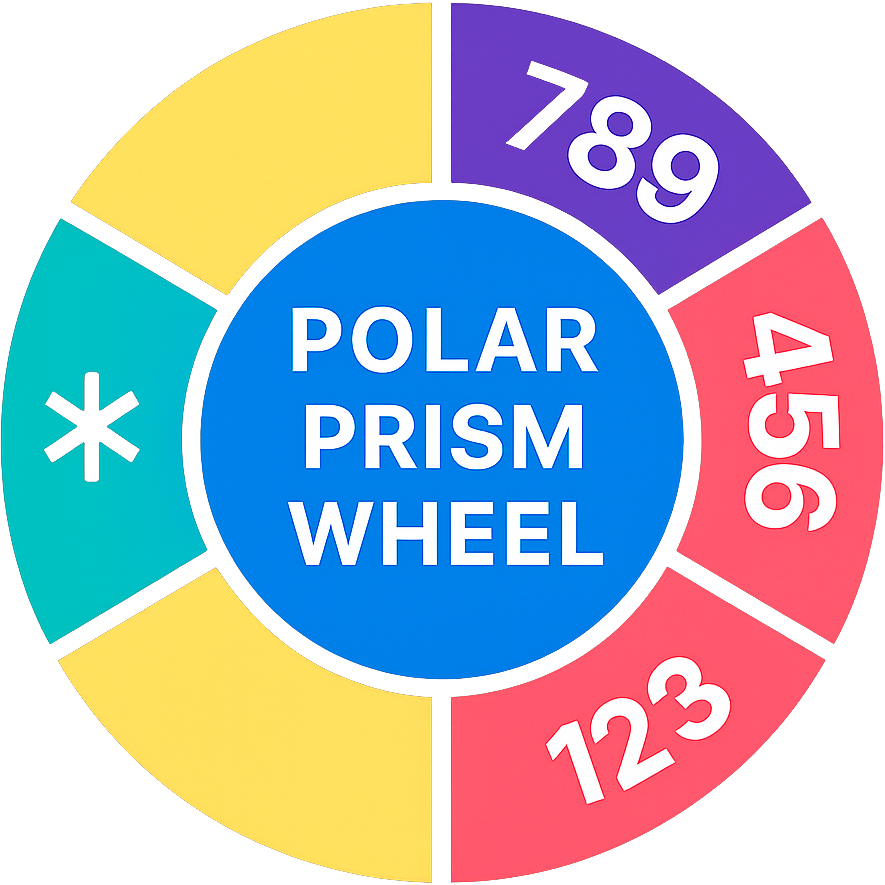
Polar Prism Wheel is an illustrative wheel-of-fortune style format. Each segment of the wheel contains a
colour, a number cluster or a symbol linked to a clearly described outcome category.
Basic rules (illustrative only)
- The wheel is divided into multiple segments with visible labels or colours.
- Participants would select a segment type or combination as explained in the rules.
- The wheel is spun and eventually stops, pointing to a single segment.
- The outcome is determined by matching the selected segment type to the result.
Practical recommendations
- Check how many segments exist and how often each segment appears.
- Understand any difference between colour bands, number clusters and special symbols.
- Remember that each spin is independent; previous spins do not influence the next one.
Example scenario
A wheel might have 48 segments split across four colour families. A person chooses one colour family in
advance. When the wheel stops, it points to a segment. If it matches the chosen colour, the person would
receive a fixed prize defined in that game’s official table. If not, the round would simply conclude.